
Alameda Directories From 1869 Forward
The Alameda city directory collection has several distinct runs. The Alameda Free Library holds the local shelf and microfilm. San Francisco Public Library records Bay Area holdings. Selected scans appear through Internet Archive and Open Library. Telephone books carry the address trail later, while the Library of Congress Sanborn atlas supplies building context rather than names.
| Collection | Years | Where Held | Access |
|---|---|---|---|
| Early Oakland and Alameda directories | 1869-1877 | Alameda Free Library microfilm | In library |
| Husted, Polk-Husted, and related city volumes | 1877-1943 | Library hardcopy; selected scans | In library or digitized edition |
| Documented Husted editions | 1889-90 through 1909-10 | AFL, SFPL, selected digital copies | Edition dependent |
| R.L. Polk combined East Bay volumes | 1925-1941 among documented editions | AFL, Open Library, Oakland Public Library | In-library or scan |
| Local telephone books | Most issues 1935-2013 | Alameda Free Library | In library |
The years describe documented holdings, not a promise that every issue survived. Catalogs show additional editions, including 1914 and 1917-18 Polk-Husted listings. Verify the volume title and locality before treating one entry as an Alameda fact.
Alameda History Room Directory Access
The Alameda Free Library Alameda History Room is on the second floor of the Main Library at 1550 Oak Street. Materials are for in-library use, and staff help may be needed for microfilm, hardcopy, or local finding aids. The Alameda Collection includes municipal reports, planning records, budgets, codes, maps, yearbooks, newspapers, clippings, and Woody Minor articles alongside the directory shelf.
The library provides obituary and genealogy research for people who resided in the City of Alameda. Current fee, turnaround, and form details were not located in the official sources reviewed, so call the library before planning a remote request. West End and Bay Farm branches can help with local access, but the historical directory materials are associated with the Main Library research collection.
Bring a year, street spelling, and possible surname. Ask for the locality key before working through a combined East Bay volume. A staff-assisted search can prevent an Oakland or Berkeley entry from being mistaken for an Alameda city directory result.
Husted and Polk Define Alameda Directories
F.M. Husted, Polk-Husted, and R.L. Polk volumes form the core publisher sequence. Husted’s Oakland, Alameda and Berkeley editions include documented runs in 1889-90, 1892-93, 1903-07, and 1909-10. Polk-Husted volumes are documented for 1911-13, 1915, and 1922-24, with catalogs also showing 1914 and 1917-18. R.L. Polk combined volumes appear in documented editions from 1925-28, 1930, 1933-35, and 1937-41.
Publishers changed the shape of the same basic trail. One year may place adult names in alphabetical order, another may add business classifications, a street guide, or an address-order section. Treat the edition as a record with its own abbreviation key. Do not silently combine a Polk entry, a telephone listing, and a deed into one household fact.
| Alphabetical names | Starts with a surname and given name or initial. |
|---|---|
| Street guide | Moves from a street address to a listed name or subscriber. |
| Classified businesses | Adds a trade or organization trail separate from household listings. |
| Publisher | Identifies which edition and abbreviation system produced the entry. |
Digitized Alameda Directory Holdings
Digitized access is useful when travel to the shelf is difficult, but a scan still needs a page-level check. The San Francisco Public Library Bay Area directory inventory helps identify which editions exist. Selected Polk and Husted volumes are searchable through Internet Archive and Open Library, while OCR can misread surnames, house numbers, and locality suffixes.
Search the digital volume by surname, then inspect the image. Copy the printed page, edition, publisher, locality mark, spouse, occupation, and address. A search result that says Alameda may refer to the county, a combined volume, or an address outside the city. The digital path is a finding aid until the page image confirms the entry.
The San Francisco Public Library Bay Area directory inventory identifies the holdings.
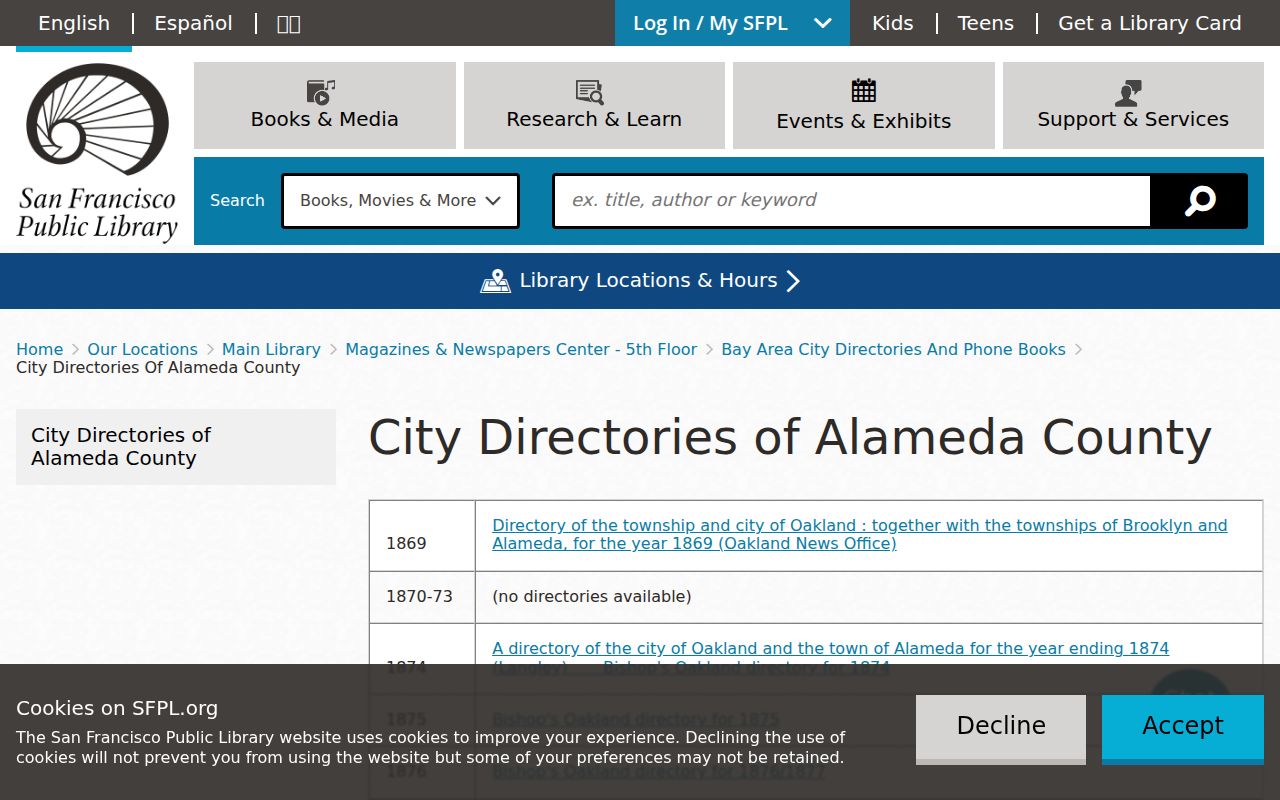
The Bay Area directory holdings screen shows why a publisher and year matter. Select the exact edition before comparing one Alameda city directory with another.
Note: A digitized OCR hit is a prompt to inspect the page image, not a substitute for the printed abbreviation key.
Reading an Alameda City Directory Entry
A typical Alameda city directory entry compresses several facts into a line. A 1941 Polk OCR example uses the form `Frank [surname] (Eva) slsmn h1522 Alameda av A`. A 1927 example uses `Terkelsen John (Anna) meats 1422 13th av h3050 California`. The printed page, not the OCR text, controls the final reading.
| Name | Surname, given name, and sometimes a middle initial. |
|---|---|
| Spouse | Often in parentheses after the listed adult’s name. |
| Occupation | A shortened trade or employer description when supplied. |
| Address | Numbered street address, sometimes with a locality suffix. |
| h or r | `h` commonly marks home or householder; `r` may mark rooms or residence. |
| wid | Can identify a widow and a deceased spouse in the entry’s shorthand. |
- Criss-cross section
- The street-order part of a directory, useful for moving from address to listed adult.
- Householder index
- A name or address aid focused on the listed head or subscriber, not a complete household.
- Abbreviation key
- The edition’s legend for occupations, residence marks, and locality shorthand; photograph or copy it first.
There is no reliable assumption that a directory symbol proves ownership. Use a deed for title, a permit for work, and a census for the household snapshot. The listing is strongest when it dates a name and place.
Alameda’s East Bay Directory Trap
Combined Oakland, Alameda, and Berkeley volumes can make a name search look more precise than it is. The locality suffix `A` is a key Alameda clue, but the address and street spelling must agree too. Search a compound surname, then read the full entry rather than trusting a name-only OCR result.
The trap matters most when two people share a surname, occupation, or spouse name. Preserve the street, number, locality, and publisher in the research log. A change from Alameda to Oakland can be a real move, an address boundary, or a combined volume’s ordering convention. A directory does not explain the reason on its own.
Alameda’s historic neighborhoods add context. Old Alameda, Encinal, Woodstock, the ferry and rail corridors, Naval Air Station material, and later Bay Farm development do not appear in one uniform record system. Use the locality mark as a first filter, then corroborate the address with a newspaper, map, deed, or permit.
Alameda Telephone Books Extend Directories
Most Alameda telephone-book issues from 1935-2013 are held at the library. They extend the city directory trail into later decades, but a telephone listing identifies a subscriber and address, not every person at the property. An absent listing may mean unlisted service, a gap in the shelf, a move, or a changed directory policy.
Use a telephone book when a city directory entry disappears. Search the prior address, the spouse, a changed surname, or a nearby street. Then compare the result with a deed, permit, obituary, or public business record. Subscriber continuity can suggest a move, but it should not be converted into a current residence claim without another source.
| Historical clue | Best companion | Question it tests |
|---|---|---|
| Directory address | Census schedule | Who was listed in the household at the nearest released decade? |
| Telephone subscriber | Deed or permit | Did the address or property change in the same period? |
| Disappearing name | Obituary or newspaper | Was there a move, death, marriage, or spelling change? |
Alameda Sanborn Maps Explain Directory Addresses
The Library of Congress Alameda Sanborn atlas covers 1897 through October 1950 in a composite of 100 sheets and 101 images. Sanborn sheets show building footprint, material, outbuildings, and street numbering. They do not name occupants. Their value is physical: a map can explain why an old directory address appears different from a later parcel.
Use a Sanborn sheet beside the directory page, not in place of it. Match the street, block, number, and structure. Then check a deed or permit for the legal property history. The moved 1003 Morton cottage, documented by the Alameda Architectural Preservation Society, is a local reminder that a building’s story and a situs address can diverge.
Sanborn geography is also helpful for family history. It can show whether a stable-looking address had a rear structure, a changed footprint, or a numbering pattern that warrants a second directory search.
Alameda Railroad and Bay Farm Directory Trails
Alameda’s record history follows its geography. Railroad and ferry development reorganized streets and places. Naval Air Station Alameda Point can send a researcher toward federal Navy publications rather than ordinary municipal sources. Bay Farm’s marsh, fill, and planned-development history means many 94502 addresses do not appear in early city directories.
For an old Alameda household, choose the trail that matches the era. Central and East End addresses often pair well with directories, maps, and newspapers. Alameda Point may need Navy newsletters, civilian material, or federal archives. Bay Farm usually needs later plats, permits, telephone books, and subdivision evidence. A missing early entry can reflect the development history, not a failed name search.
Trace an Alameda City Directory Household
Family history works best as an edition-by-edition timeline. Start with the strongest known year and copy the full entry. Move one issue at a time. Record the street, spouse, occupation, locality suffix, and any `h`, `r`, or `wid` mark. Pair the directory years with released federal census schedules through 1950 to add ages, relationships, birthplace, and neighbors.
- Find the first reliable appearance and save the publisher, year, page, and abbreviation key.
- Follow the name forward, noting every address change and every spelling variation.
- Use the street guide or criss-cross section to test an address when the alphabetical entry is unclear.
- Pair the closest directory year with a census schedule and compare household members and neighbors.
- When a listing stops, search the next telephone book, obituary, newspaper, deed index, and probate record.
Disappearance is an open question. The person may have moved, died, married, changed a name, lost a listing, or fallen into a missing issue. A probate file can connect a decedent, petitioner, personal representative, heirs, and later deed, but confidential guardianship and conservatorship material is excluded from ordinary online probate images.
The city directory page owns the historical collection method. For modern parcel and deed work, use the Alameda street directory by address so the two trails stay distinct.
Alameda Museum Cross-Checks Directory Names
The Alameda Museum’s history materials include newspapers reaching into the 1880s, residence and family files, business files, and a reported image collection of about 6,000 photographs. The museum can supply visual context or a family clue organized by residence street or surname. It is a finding aid and context collection, not a replacement for a deed or certificate.
Yearbooks, newspaper notices, city directories, and local clippings can reconnect a former classmate or clarify a household move. California Digital Newspaper Collection and OAC add regional and archival trails. Funeral notices are private publications and should be confirmed with civil evidence. Preserve a clipping’s publication date and page so a later search can retrace the conclusion.