
Find Alameda Residents From the Right Clue
Name the clue before you touch a search box. An Alameda address belongs in the county parcel system first. A person tied to a deed belongs in the recorded-document party index. Questions about a birth, death, or marriage go to the Clerk-Recorder. Others go to the California Department of Public Health. An older household may surface only in a city directory, telephone book, census schedule, or newspaper. Some appear only in a museum file.
Every public record gives a partial view. An assessor entry names a parcel, its owner, the tax mailing address, and property facts. Yet it cannot prove who occupies the land. A directory listing names one adult or subscriber, not the whole household. The strongest Alameda resident result rests on two independent clues. That means a full name plus an address, spouse, middle initial, event date, parcel number, or business tie.
- Use the Alameda County Assessor Parcel Viewer when the starting clue is a street address or APN.
- Compare the parcel result with a current deed party and a recorded-document date.
- Use Alameda court, vital, business, license, or obituary sources for the kind of event in question.
- Move to Alameda Free Library collections when the question reaches into earlier households.
- Ask the department that keeps the record when a needed index or image is not online.
Note: A name-only match is a lead, not an identity; time, place, and a second record must all agree before the link holds.
Alameda City and County Use Different Records
Alameda is a city inside Alameda County, and Oakland holds the county seat. That fact decides your first phone call. City Hall and the city permit system keep municipal building evidence. Planning material and local documents sit there too. County offices hold the assessor roll, deeds, vital certificates, elections records, and Superior Court files. Stay inside one jurisdiction and you may miss the record that explains the address or the person.
Split the work by type. Permits, inspections, zoning, historic preservation, and municipal records live on the city side. Property ownership, recorded instruments, certificates, court cases, and election administration live on the county side. Each department retains its own records. A request must therefore name the keeper rather than ask for one countywide resident file.
The name Alameda also shows up in countywide, citywide, and regional collections. Label every result with its jurisdiction. A combined East Bay directory can park an entry in Oakland or Berkeley. Its address and locality suffix must point back to Alameda.
Alameda Resident Records Offices
These offices form the working map behind Alameda resident records. Each one keeps different evidence. The Clerk-Recorder holds deeds and recorded instruments. It also holds birth and death certificates, public and confidential marriage records, and fictitious business names. The Assessor identifies parcels and property facts. The Registrar of Voters controls voter-file access and the self-service status tools.
Alameda County Registrar of Voters
1225 Fallon St., Room G-1
Oakland, CA
510-272-6973
County counter service earns its keep when an online index stops at a name or instrument number. The Clerk-Recorder lists Oakland and Dublin service locations. The court, election, and assessor offices set their own access rules. Contact the custodian before treating any result as current.
Start With Alameda Parcel Search
The Alameda County Assessor Parcel Viewer is the practical first stop for an address clue. It accepts a site address, an APN, or a map selection. Save the APN and the displayed situs address before moving on. A map click helps most with a corner parcel, a multi-unit building, or a street where similar numbers crowd together.
| Site Address | Street-based route for locating the parcel tied to a physical place. |
|---|---|
| APN | Assessment parcel identifier; preserve zeros and punctuation as displayed. |
| Map Selection | Click a polygon when a typed address is unclear or adjacent parcels matter. |
| Parcel Card | May show ownership interest, tax mailing address, assessed values, and property characteristics. |
The assessor is not a household roll. California Government Code section 6254.21 limits remote owner-name searching, so address and APN lookups are the useful public route. A tax mailing address is just an administrative destination. If it differs from the situs, it may point to another parcel or mailing location, never to an occupant.
The Alameda property-tax search adds secured, supplemental, and delinquent account context. It is not title evidence. Keep assessor, tax, deed, and occupancy questions separate.
The parcel-search screen shows the address-first route in action. Treat the returned parcel as a bridge to a party name, permit search, or adjacent-parcel review, not as proof of who lives there.
Current Alameda Residents Directory Sources
Alameda's current resident sources work best as several records with different coverage. Property records describe land and ownership. A voter status tool authenticates one voter instead of opening a street list. Court, business, license, and unclaimed-property systems tie a name to a public event or role. The table keeps those purposes distinct.
| Source | What It Can Add | Keeper | Access |
|---|---|---|---|
| Parcel and tax records | APN, situs, mailing, ownership interest, property facts | Alameda Assessor and Treasurer-Tax Collector | Address/APN search |
| Recorded-document index | Grantor, grantee, instrument type, date, party trail | Clerk-Recorder | Free party index; image by office or order |
| Court indexes | Case number, parties, filings, hearings, permitted images | Alameda Superior Court | eCourt, Odyssey, terminal, or request |
| Voter status | One authenticated voter’s status and election details | California and Alameda election offices | Self-service only |
| Business and license filings | Entity, agent, license status, business address | California Secretary of State and DCA | Public online searches |
Pick the source that matches the fact. A name on a deed is not proof someone lived there. A professional license shows a regulated name and status. Yet its address may serve a business or a mailbox. A court party can belong to a case. It can do so without belonging to any parcel in Alameda County.
When one person becomes the focus, the Alameda resident lookup workflow gathers the identity checks in one place. A street question belongs with the address chain. The historical shelf belongs with the city directory collections instead.
The Recorder Index Needs a Name
The Alameda County Official Public Records Index searches by party name only. It does not search by address or APN. Useful fields include party or grantor-grantee name, instrument number, and a recording date or range. Document type completes the list of useful fields. Start from the current owner or another known party in the parcel record. Search both sides of a transfer, and copy the exact spelling the result shows.
Alameda County has recorded real-property instruments since 1853. The online party index reaches back to 1969; earlier alphabetical indexes live on microfilm. Treat the remote index as a discovery layer. Government Code section 7928.215 bars posting recorded images online. View or order the instrument through the Clerk-Recorder.
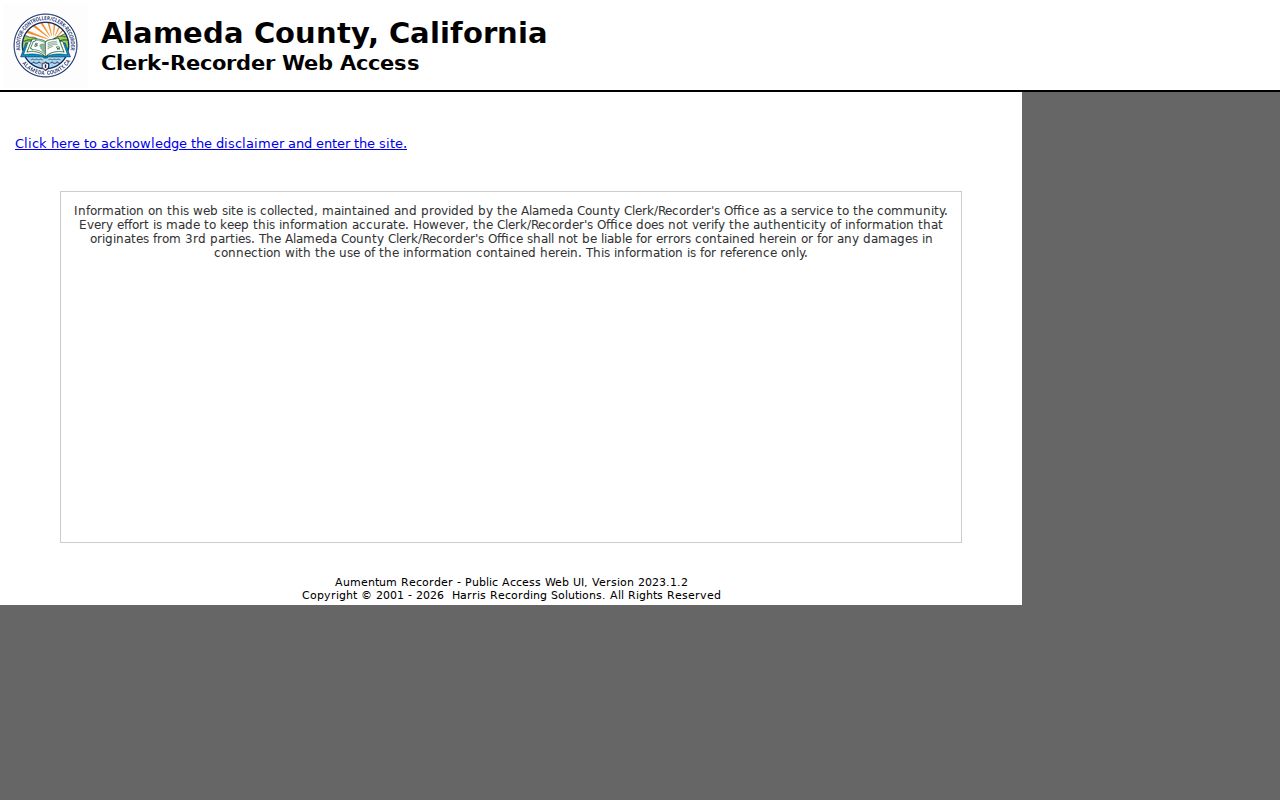
The index page shows why the assessor-to-party bridge matters. Note the instrument number, party role, date, and document type. Then use the office ordering route for the legal description and signatures.
Note: The recorder's name index can follow an owner. But it cannot by itself identify every person connected with the address.
Alameda Court Names and Dockets
Alameda Superior Court splits its public search work between eCourt and Odyssey. eCourt handles civil, small claims, family, probate, mental health, and related divisions. Its name and case-number searches run through accounts. Odyssey supplies free criminal information for cases with activity since 2005. A courthouse terminal can surface public documents the remote view never shows.
A docket is the court's chronological case record. A result can display case number and title. It can also show party names, the Register of Actions, minutes, future hearings, and image links or previews where permitted. Sealed, juvenile, adoption, guardianship, conservatorship, and other confidential material stays closed. That rule holds no matter how a request is phrased.
The Alameda Superior Court records-information page separates eCourt, Odyssey, terminal, and request access.
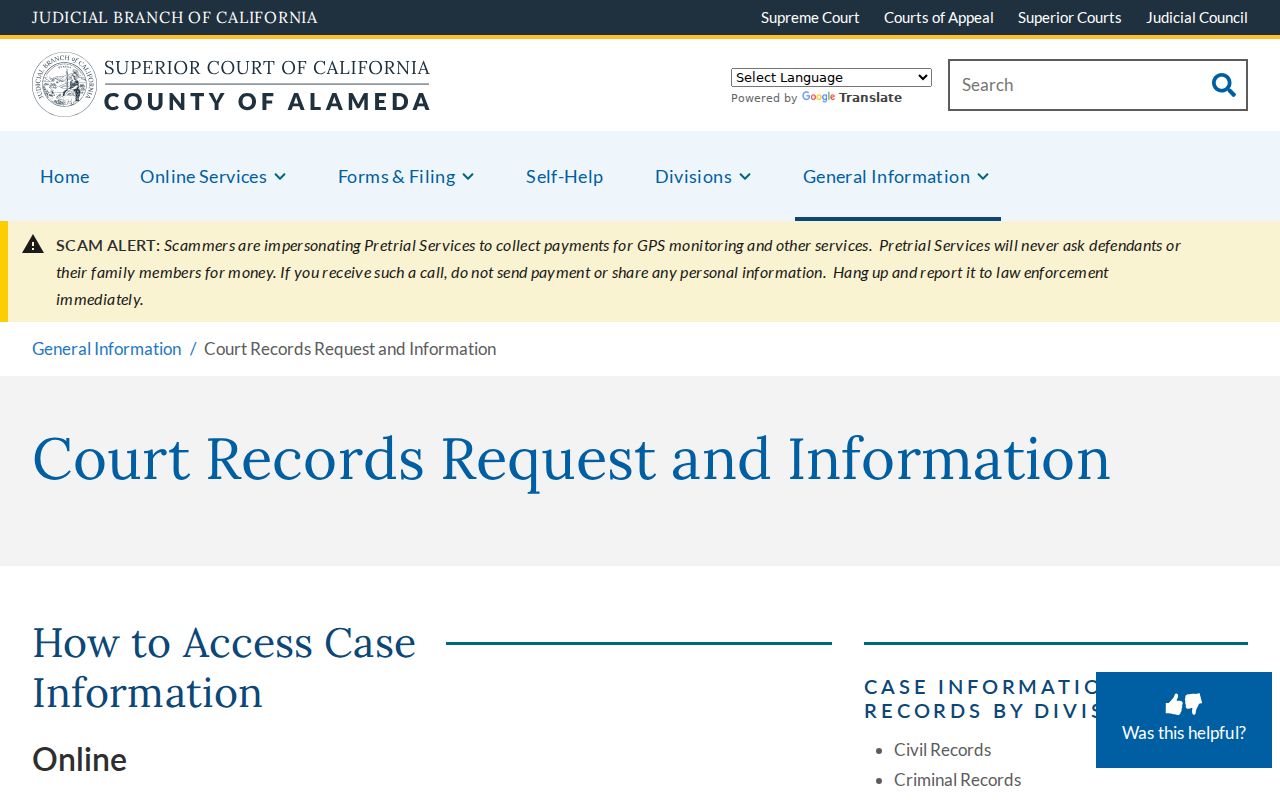
The court-records page makes the access split plain. When an online search stalls, the court offers courthouse terminals and mail requests, and staff point to the right division without doing research by phone or email.
California Voter Status Is Self-Service
California My Voter Status and Alameda My Voter Profile answer a voter's own questions. The state registration-status page routes voters to those official services. Authentication asks for first and last name and date of birth. It also requires a driver license or state ID, and the last four Social Security digits or a no-number choice. Exact matching is required.
A returned result may cover status and polling place. It can also include ballot and sample-ballot details, language, districts, and party preference. It is not an open Alameda resident roll. Approved voter-file applicants follow a separate regulated process. It falls under California Elections Code sections 2187 and 2194 and related regulations. Commercial use, unapproved solicitation, harassment, and similar misuse are prohibited.
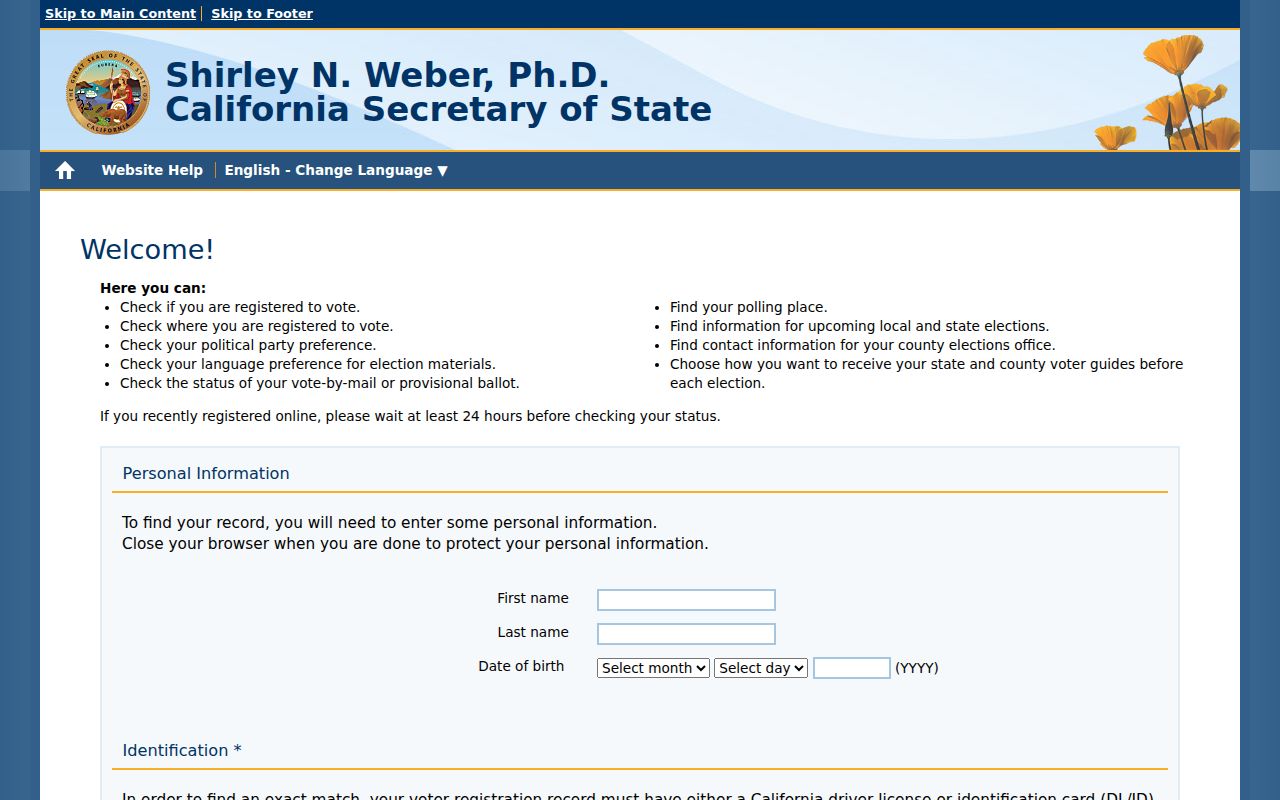
The authentication screen itself is a reminder. Election data is built for the registered voter and qualified file requests, not for street-by-street browsing of Alameda neighbors.
Note: A voter status result confirms a voter's election record, not residence, household membership, or the identity of an unregistered person.
Vital Certificates Answer Narrow Questions
Alameda County Clerk-Recorder handles some certificate service. The California Department of Public Health handles the rest. Birth, death, and marriage records are split between them. California separates authorized certified copies from informational copies. This falls under Health and Safety Code sections 103525 and 103526. An informational copy can carry the event facts. But it is marked not valid to establish identity. Authorized copies demand the statutory relationship, authority, and sworn statement.
Access rules differ by record type. Confidential marriage certificates go only to the parties or a legally authorized requester. Adoption court files are confidential and need a court order. The statewide CDPH service helps when the county of event is unknown. Direct third-party online-vendor applications stopped after July 1, 2026.
The Alameda County Clerk-Recorder services page shows the county's certificate, deed, and related-record access paths.

The Clerk-Recorder services page connects certificate questions to the right forms and counter. It does not turn a certificate request into a searchable Alameda residents directory index.
Business and License Records Add Anchors
Business records steady a shaky name match. They leave their own trail. The California Secretary of State bizfile search takes a name or a file number and offers advanced filters for narrowing results. A filing may list formation, status, jurisdiction, street or mailing address, registered agent, Statement of Information dates, and document links. County fictitious business name files cover local trade names. The California Department of Consumer Affairs license search adds a regulator's view. It returns board, license type, status, issue and expiration details, and public discipline where a board publishes it. Treat addresses as separate facts. A business address is not a residence. Agent, mailing, and parcel situs details each carry their own meaning, so weigh them separately before tying any filing to a person in the Alameda residents directory.
The state's business-search screen displays the entity layer. Match a filing to an Alameda person only after checking the entity name, date, agent, address type, and any separate license record.
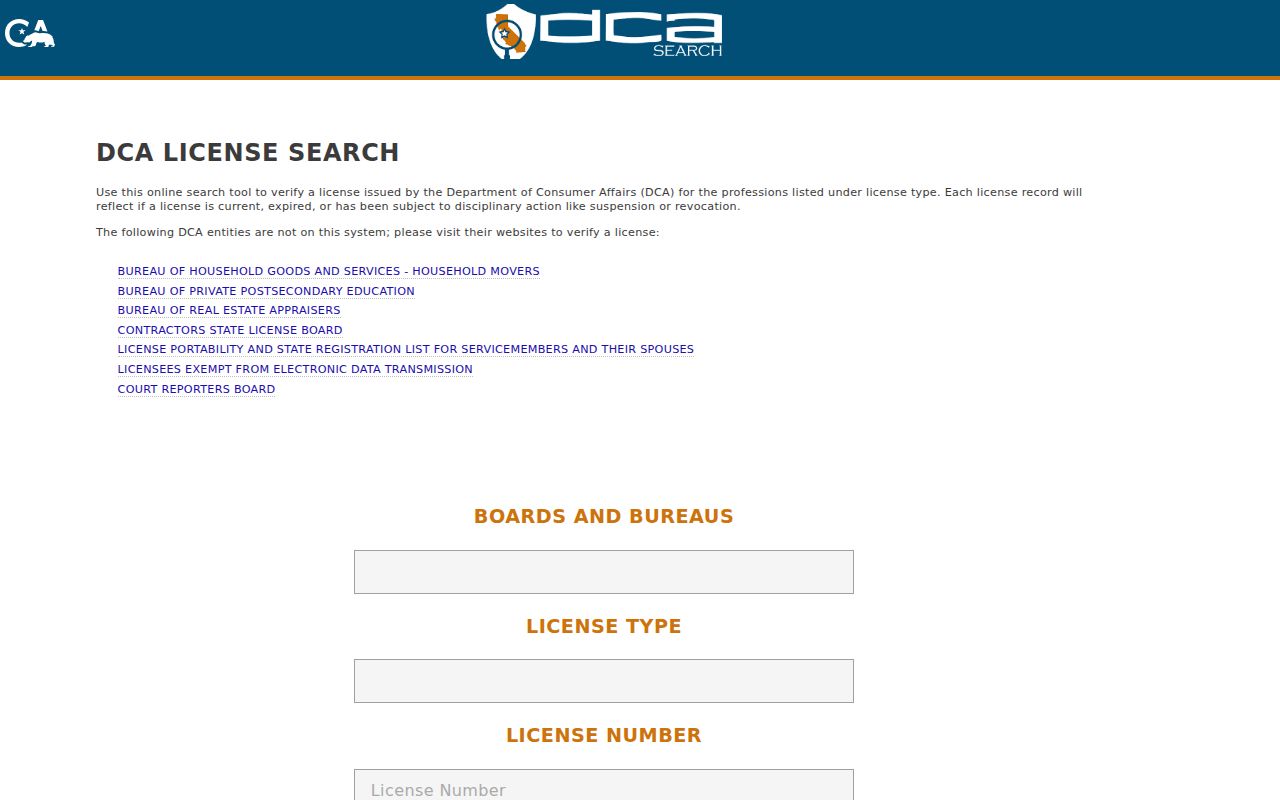
A license search adds a regulator's status trail. Public addresses vary by board, though, and may point to an office rather than a home in an Alameda resident lookup.
When an Alameda Search Leaves the Web
State law keeps the door open. The California Public Records Act lets any person request reasonably identified nonexempt records under Government Code section 7922.530. An agency generally gets ten calendar days to make a disclosure determination under section 7922.535, and a complex file may still take longer to produce. A written unusual-circumstances extension can add fourteen more days. The deadline covers the decision alone.
Use the Alameda County public-records request route when a department's ordinary search falls short. Be specific. Name the department, record type, address or APN, date span, and any known instrument or permit number. City records go through the City Clerk route. Police records use APDRecords@alamedaca.gov, and the county warns that no single central repository holds every record.
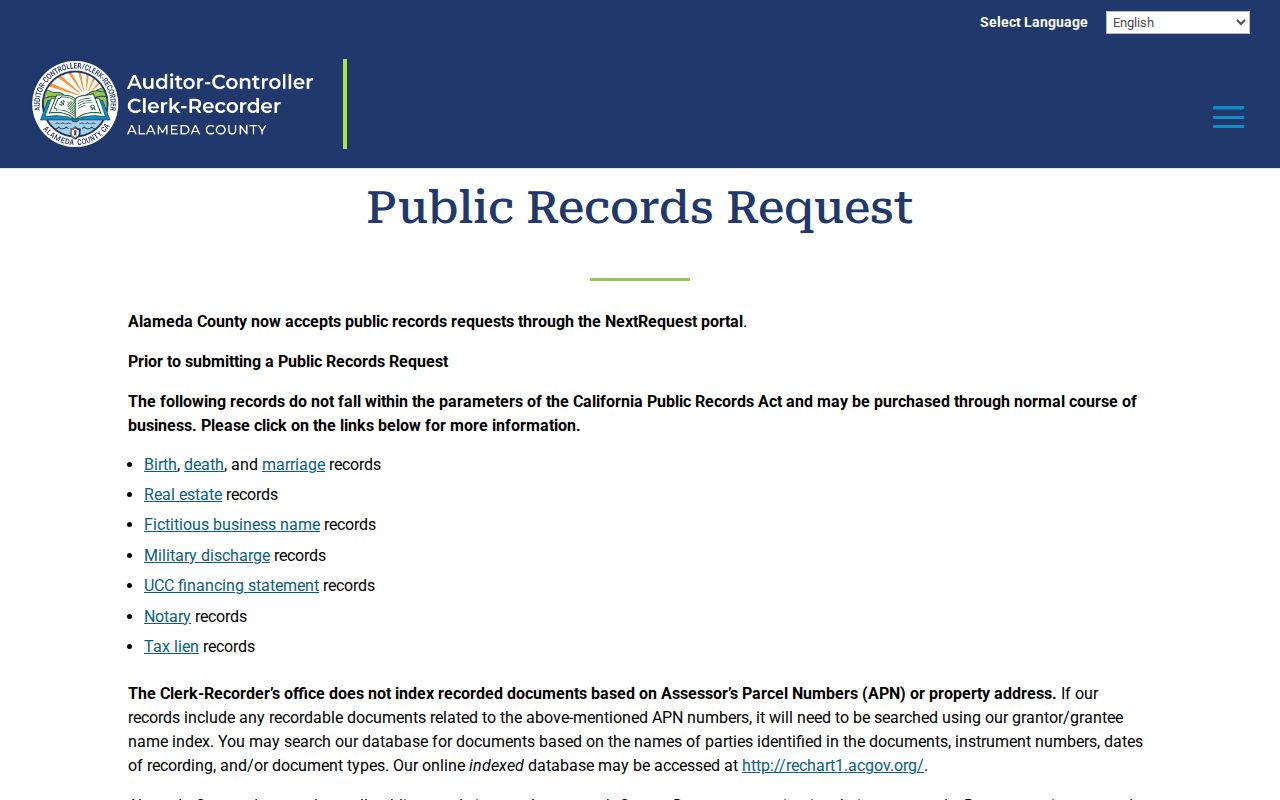
The county's request page shows the fallback chain. The route is formal but simple. A requester identifies the custodian, asks for a specific nonexempt record, and expects direct duplication or statutory service costs where they apply.
Note: A missing portal result never proves a record did not exist; it may point to a different department, date range, format, or access channel.
Alameda Free Library Keeps the Older Trail
Older records live at the library. The Alameda Free Library's Alameda History Room preserves the resident trail that modern county portals cannot reach. Its holdings include city directories, telephone books, maps, yearbooks, newspapers, clippings, municipal reports, planning records, and local-history files. The Main Library collection sits on the second floor. It is for in-library use only. Staff obituary and genealogy help is limited to people who resided in the City of Alameda.
The directory run starts with 1869-1877 microfilm. Hardcopy directories continue through 1943, beginning in 1877. Most local telephone books extend the trail through 2013. Sanborn maps from 1897 through October 1950 show buildings and street numbering. The Alameda Museum adds newspaper, residence, family, and image files. These are evidence layers, not current rolls.
The full sequence, entry abbreviations, and year-by-year method sit on the Alameda city directory page. A short directory entry can name a listed adult, spouse, occupation, and address, so pair it with a census, deed, obituary, or permit before any family-history conclusion.
Protected Addresses Need a Stopping Rule
Confidentiality programs draw a hard line. California Safe at Home can place a substitute mailing address in government records for eligible participants. Confidential voter registration removes the ordinary voter-file trail too. The program does not erase a legal description when a participant buys property in a personal name, and private groups need not accept the substitute address. A protected address is a boundary, not a puzzle.
Lawful personal research. Alameda records are useful for family history, property history, civic questions, and reconnecting through proper channels. Do not use a result to stalk, harass, intimidate, or harm anyone.
Verify with the custodian first. Correct errors at the office that created the record. Stop when a confidentiality program or court restriction applies. No search engine or directory service can amend a deed, assessor roll, voter record, docket, or certificate.
Recent Alameda Records Changes
Several 2026 changes affect Alameda record research. Certificate fees rose on January 1, 2026. That was when California's Department of Public Health raised its direct charges. The Delete Request and Opt-Out Platform, known as DROP, opened consumer submissions on January 1. Registered brokers begin processing requests on August 1. A mail process for approved diacritical-mark amendments started July 1.
Alameda's current business-license layer uses HdL and publishes active and monthly new-license files. The Superior Court keeps its distinction intact. Free criminal information flows through Odyssey, while public documents remain available at kiosks. None of this creates an all-purpose Alameda residents directory. Each change only shifts the best access route for a narrow record type.
For a current fact, use the live agency page and note the date you checked. For an older fact, preserve the edition, document number, or downloaded file. A later change then cannot erase the trail.